There are certain thinkers whose work informs our profession, and then there are those rare voices whose ideas fundamentally alter the way we see our work. For me, Mary Broad was one of those voices. Mary passed away earlier this year, at 99 years of age.
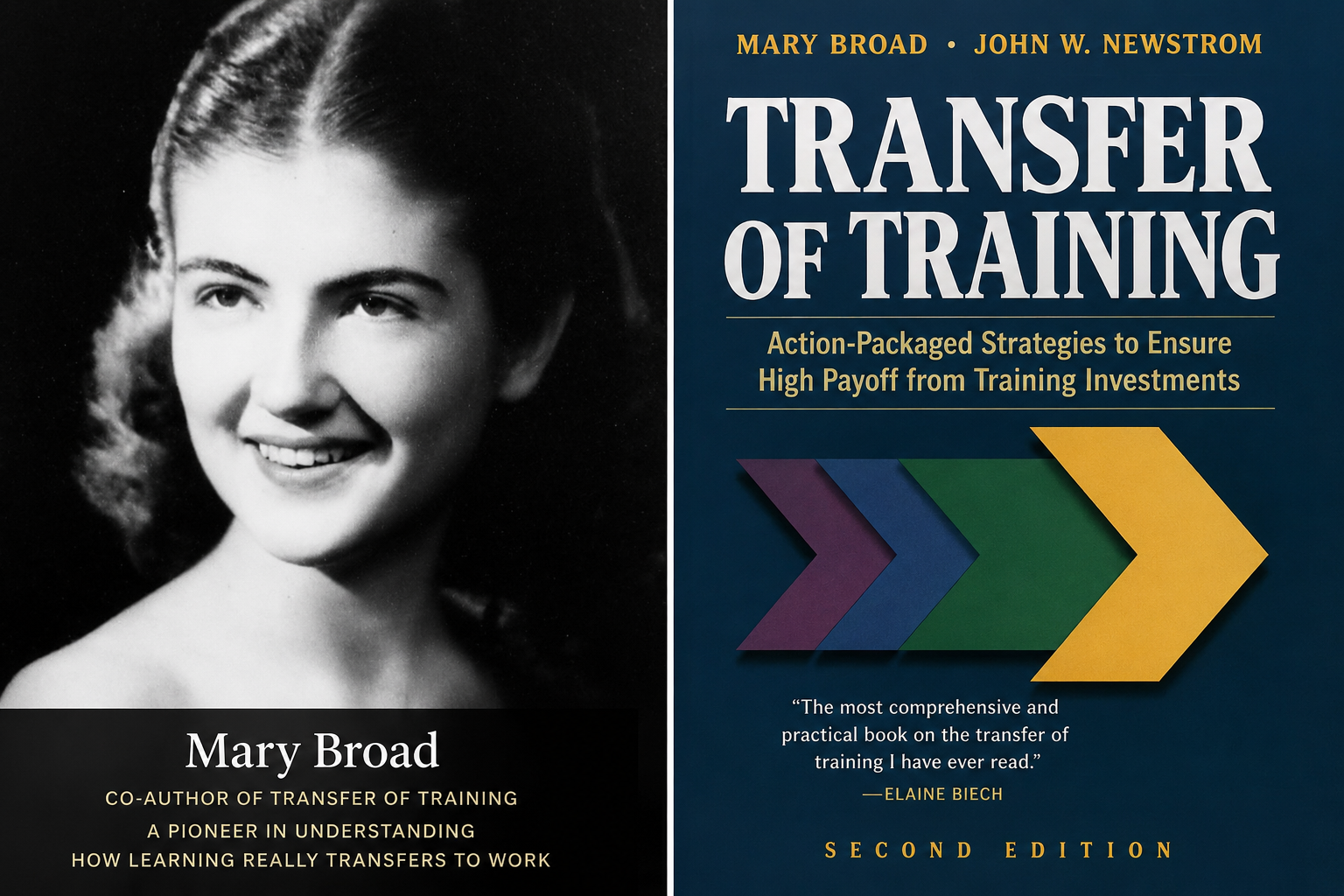
Mary Broad and the enduring influence of Transfer of Training—a work that challenged us to think beyond the classroom and into real-world application.
When I first encountered Mary Broad and John Newstrom’s Transfer of Training (1992), it did not merely add to my understanding of learning and development—it transformed it. At a time when much of leadership development still followed a familiar pattern of designing strong classroom experiences and trusting that learning would somehow transfer into better leadership, Broad challenged me to think more deeply about what actually happens after the learning event ends.
Her work illuminated what I had sensed but had not yet fully articulated: leaders do not leave a classroom and return to some protected environment where reflection and experimentation naturally occur. They return to meetings, deadlines, difficult conversations, staffing issues, operational fires, and the relentless pressures of organizational life. In that reality, even the best intentions to apply new learning can quickly give way to old habits and familiar patterns of behavior. Broad helped me understand that the question was never simply, “Was the program good?” but rather, “What happens when the learner goes back to work?” That question changed everything about how I designed leadership development.
Most profoundly, Broad expanded my thinking from the individual learner to the broader ecosystem surrounding that learner. Transfer of training was not the sole responsibility of the participant; it was a systemic endeavor. The learner’s supervisor needed to reinforce and support new behaviors. Coaches, mentors, peer accountability, and performance expectations all had a role to play. Organizational systems themselves—performance management, culture, leadership expectations, and feedback mechanisms—either supported behavior change or quietly undermined it through indifference. Rather than placing an unrealistic burden on the learner to independently transform after a workshop, Broad invited us to think holistically about the conditions that make growth possible.
I still carry these lessons today. Nearly every leadership program I have designed has been shaped by this understanding that development is not an isolated event but a leadership journey embedded within a larger system. If organizations truly care about meaningful outcomes—about leaders who think differently, behave differently, and create healthier teams—then they must care deeply about transfer. In many ways, Mary Broad gave me permission to stop seeing leadership development as content delivery and start seeing it as organizational change work. That shift has stayed with me throughout my career, and for that, I remain deeply grateful.